


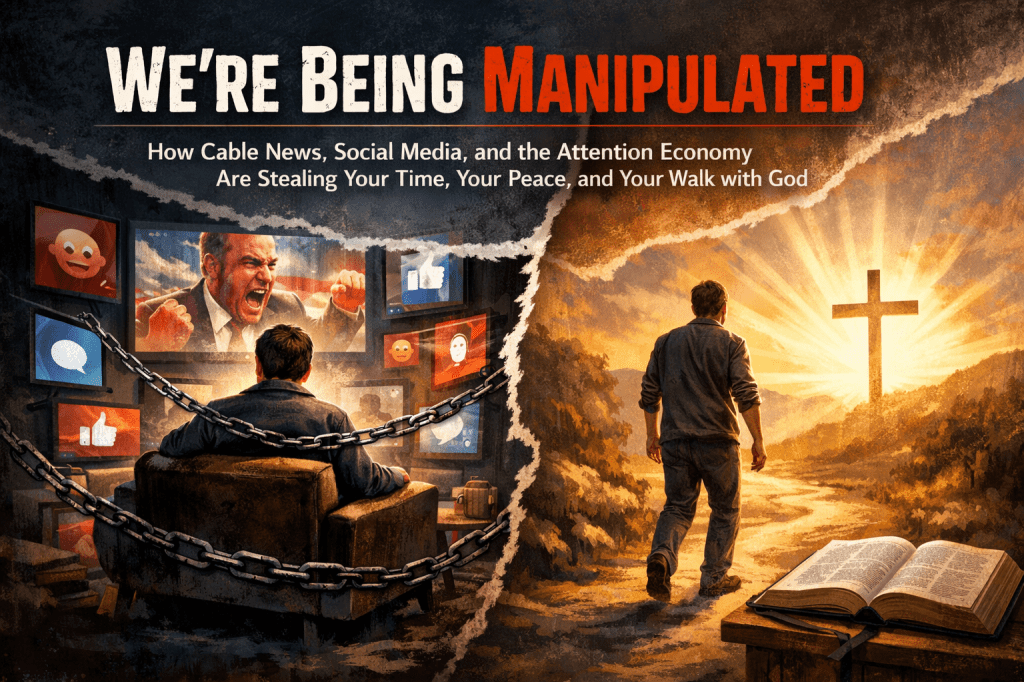
How Cable News, Social Media, and the Attention Economy Are Stealing Your Time, Your Peace, and Your Walk with God
The average person will spend over seven years of their life watching television. Add social media, and Americans are now spending more than 17 years of their adult lives online.
That’s not a hobby. That’s almost a career. And here’s the question nobody seems to be asking: who’s writing the script for that second life?
It’s not you and it’s definitely not for your benefit.
I’ve been sitting with some statistics recently that stopped me in my tracks. Not because I didn’t suspect the numbers were bad, but because when you stack them up next to our spiritual habits, the picture that emerges is one we can’t afford to ignore.
The Numbers Don’t Lie
The average American spends over seven hours per day on screens. About four of those hours are on a phone. The rest are watching television or streaming services on a computer, iPad, etc. Together, that accounts for roughly a third of your entire life. Four full months out of every year spent on devices.
Social media alone eats two hours and sixteen minutes per day. That’s more than 800 hours a year of scrolling. Add it all up, and we’re spending 42 percent of our waking hours staring at a screen.
Now here’s where it gets personal.
A Lifeway Research study found that only 45 percent of regular churchgoers read their Bibles more than once a week. For those who do, the average time spent is somewhere between 5 and 30 minutes. Even if we’re generous and say 30 minutes a day, that totals roughly one week per year in God’s Word.
One week in the Word. Four months on screens.
That’s a ratio of 1 to 16. We are giving our devices sixteen times more of our attention than we give to God.
If what we feed grows and what we starve dies, what are we growing? And what are we letting die?
What They’re Feeding You
If you think all that screen time is at least keeping you informed, the data says otherwise.
According to Pew Research Center, 63 percent of all cable news airtime is opinion and commentary. Only 37 percent is actual news reporting. Political topics dominate the cable news agenda far more than any other subject. During election years, networks like MSNBC devoted over 57 percent of their total coverage to a single political campaign. Their top four stories (all Washington politics) consumed 55 percent of total airtime.
Research from the University of Pennsylvania’s Computational Social Science Lab confirms that cable networks have grown more polarized over the last decade, especially after 2016. They deliberately select hot-button topics that match their audience’s political leanings. Not topics that inform or equip viewers, but topics that inflame them.
You sit down to “stay informed,” and nearly two-thirds of what you’re watching isn’t news. It’s someone’s opinion about news. Dressed up with a panel of so-called experts who are really just there to argue.
One side says something outrageous. The other side reacts. You sit there getting more and more frustrated. That’s not an accident. That’s the product.
The Outrage Machine
Here’s what most people don’t realize: the system is designed to make you feel bad, because that’s what keeps you engaged.
Studies show that negative headlines increase consumption rates, especially on topics like government and the economy. High-emotion content, specifically fear and anger, increases online sharing behavior. The algorithm literally rewards what upsets you.
And here’s the cost we’re paying:
A 2019 study of 800 Americans found that 40 percent reported stress from political media consumption. Twenty percent reported poor sleep and depression. And 10 to 30 percent reported feelings of anger and hate triggered directly by political content.
An MIT study found that access to Facebook alone led to a 7 percent increase in severe depression and a 20 percent increase in anxiety disorder. Youth spending more than three hours a day on social media face significantly higher risk of anxiety, depression, and poor sleep. The U.S. Surgeon General has issued a formal advisory on social media and youth mental health. And nearly half of teens now say social media has a mostly negative effect on people their age, a number that’s up 16 points in just two years.
We’re not being informed. We’re being activated and there’s a critical difference. Information equips you to think. Activation tells you what to think, and more importantly, what to feel. The feelings they want from you are anger, fear, and outrage, because those emotions keep you scrolling, keep you watching, and keep the ad revenue flowing.
Your Representatives Aren’t Solving Anything Either
You might think that at least our leaders in Washington are working on solutions while we’re consuming all this content. They’re not. They’re playing the same game.
Political parties tell new members of Congress to spend roughly 30 hours per week fundraising during campaign seasons. A leaked schedule from the Democratic Congressional Campaign Committee showed members are expected to spend four hours per day on “call time,” dialing for dollars at a phone bank across the street from the Capitol. Out of a 9-to-10 hour workday, only about two hours are expected to be spent on actual legislation. The job they were hired to do.
Members in competitive races raise over $6,500 per day. Some senators raise $287,000 per day and 92 percent of members of Congress have leadership PACs, which are essentially second fundraising operations often funded by special interests.
Here’s how the loop works: A politician says something provocative. Cable news runs a panel about it. Social media lights up. People get angry. They share. They donate. The politician gets more airtime. The network gets more viewers and nothing gets solved.
In 2024, we spent over $12 billion on political ads. Most of them were attack ads designed to make you afraid of the other side. You know what $12 billion could also do? The National Alliance to End Homelessness found it would cost about $9.6 billion to provide housing placements for every person who used a homeless shelter in America. Less than one election cycle of attack ads. We could have housed them all and had billions left over.
But housing people doesn’t get clicks. It doesn’t trend. It doesn’t keep the machine running.
But Here’s the Part Nobody Wants to Talk About
It’s easy to point at the system. The media. The politicians. The algorithms. Yes, they are definitely broken. But they only have power because we give it to them. Every click. Every scroll. Every hour we hand over.
That’s not just a media problem. That’s a heart problem.
Jesus said in Matthew 6:22, “The eye is the lamp of the body. If your eyes are healthy, your whole body will be full of light. But if your eyes are unhealthy, your whole body will be full of darkness.”
What you give your eyes to, you eventually give your heart to. Right now, we’re giving our eyes to outrage panels, political arguments, and an endless scroll of content designed to make us angry or afraid. Then we wonder why our hearts feel heavy. Why our walk with God feels dry. Why we’re anxious and restless.
It’s because we’ve been feeding the wrong thing.
Four Sins Hiding in Your Screen Time
This isn’t just a time management issue. It’s a spiritual formation issue. And the damage shows up in ways we don’t even recognize. Let me name four.
Idolatry. When you reach for your phone first thing in the morning before you reach for the Word, that’s not just a habit. That’s a heart posture. You’re looking to a screen for significance, for feedback, for a sense of control that only God can provide. You’re asking a device to do what only a Savior can do. Tell you who you are. Tell you that you matter. Tell you what’s happening and that everything’s going to be okay.
Slothfulness. Doomscrolling feels like you’re doing something. It feels like awareness, but it’s actually the opposite of action. It’s passivity dressed up as engagement. You’re choosing ease over the hard work of spiritual growth, of investing in your marriage, of being present with your kids, of fulfilling the calling God put on your life. Proverbs calls that the way of the sluggard and the sluggard always has a reason why he’s sitting still.
Coveting and Comparison. Social media is the underbelly of comparison. You see someone else’s marriage, someone else’s platform, someone else’s body, someone else’s success, and something in you says, “Why not me?” That’s not ambition. That’s a rejection of God’s providence. It’s looking at the life God gave you and saying it’s not enough. Even more, most of what you see is staged…think of the family pictures you post. How much preparation went into those?
Fear and Distrust. Constant news-checking and information surveillance create an illusion of control. If I just know enough, I can stay ahead of it. If I just stay informed, I won’t be caught off guard, but that impulse, when it becomes compulsive, is actually a form of distrust. It’s your soul refusing to rest in God’s sovereignty. It’s the opposite of what the Psalms call us to: “Be still, and know that I am God.” I have been VERY guilty of this one this past week with the war on Iran…I get it.
Idolatry. Slothfulness. Coveting. Fear. Four sins hiding in plain sight, disguised as morning routines and media habits.
A Different Design for Leadership
Now, here’s where I want to take this somewhere most people won’t. Because I’m not just frustrated by this. I believe there’s a design for leadership, and for life, that looks nothing like what we just described.
Proverbs 16:32 says, “Better a patient person than a warrior, one with self-control than one who takes a city.” The media machine rewards people who “take cities,” who dominate, who win the news cycle. God’s standard is self-control. Restraint. Strength under control, not strength on display.
In 1 Peter 5:2-3, Peter writes, “Be shepherds of God’s flock that is under your care, watching over them, not because you must, but because you are willing. Not lording it over those entrusted to you, but being examples to the flock.” The cable news panel lords opinions over people. The politician lords power for personal gain. Peter says: be an example.
In Matthew 20:25-28, Jesus said, “You know that the rulers of the Gentiles lord it over them. Not so with you. Instead, whoever wants to become great among you must be your servant.” Jesus didn’t say leadership is bad. He said the world’s version of leadership is bad. Servant leadership isn’t weakness. It’s a total reorientation of who you serve.
The Antidote: What If We Chose Differently?
What if cable news spent even half its airtime on solutions instead of arguments? What if instead of a four-person panel debating who’s wrong, they brought on people working on what’s right? People actually solving homelessness, addiction, fatherlessness, and illiteracy in their communities?
What if politicians spent those four hours a day (the ones currently dedicated to dialing for dollars) actually serving the people who elected them?
What if we took back even one hour of the two-plus hours we spend on social media every day and invested it in something that actually made us better? Better fathers. Better husbands. Better leaders. Better men.
We have more access to the Bible than any generation in history. It’s on your phone right now. You can pull it up in two seconds, but proximity to truth is not the same as spiritual formation. Having a Bible app doesn’t mean you have a Bible life and watching a sermon online, valuable as it can be, is a supplement, not a substitute for sitting in the Word yourself and sitting in community with other believers.
Five Challenges for This Week
Here’s what I’m challenging myself, and you, to do:
1. Recognize the ratio. One week in the Word versus four months on screens. Sixteen to one. That ratio is a mirror, and it’s showing us where our hearts really are. Not where we say they are on Sunday morning, but where they actually live Monday through Saturday.
2. Fight for your gaze. What you give your eyes to, you give your heart to. Every time you close an app to open your Bible, that’s not discipline. That’s an act of devotion. That’s worship. Romans 12:2 says, “Do not be conformed to the pattern of this world, but be transformed by the renewing of your mind.” Every time you choose the Word over the scroll, you’re choosing transformation over conformation.
3. Refuse to be fuel. When you feel that pull to share the outrage post, to rage-watch the panel, to check the news for the fifteenth time today, recognize it. That’s not conviction. That’s not responsibility. That’s manipulation and underneath it might be fear, or idolatry, or sloth. It deserves to be examined, not indulged.
4. Replace, don’t just remove. For every hour of cable news or political scrolling you cut, invest 30 minutes in Scripture, a book, a real conversation with your wife or kids, mentoring a young man, or building something in your community.
5. Lead like a servant, not a commentator. The world has enough people with opinions. It needs people with actions. In your home, your workplace, your community, be the leader who solves, not the one who shouts.
This Is a Fight for Your Soul
Brothers, we are being manipulated. Not because we’re stupid, but because the system is designed to exploit our God-given desire to care about the world but caring was never meant to look like consuming. It was meant to look like serving.
This is also a fight for our souls. The enemy doesn’t need you to reject God outright. He just needs to keep you distracted long enough that your faith becomes shallow, your family gets neglected, and your calling goes unfulfilled. A screen can do that just as effectively as any vice. Maybe more so, because it feels productive while it’s hollowing you out.
So, let’s take our time back. Let’s take our gaze back. Let’s take our hearts back and let’s lead the way God intended.
What’s one thing you’re going to change this week about how you steward your attention? Drop it in the comments below, and if this hit home, share it with a brother who needs to hear it.
Stay unleashed.
Sources
- Pew Research Center, “The Changing TV News Landscape” (2013)
- Pew Research Center, “How Americans Get TV News at Home” (2013)
- Pew Research Center, “Social Media and News Fact Sheet” (2025)
- Pew Research Center, “Teens, Social Media and Mental Health” (2025)
- University of Pennsylvania CSSLab, “Unpacking Media Bias in Cable and Network News” (2025)
- Annenberg School for Communication, “Cable News Networks Have Grown More Polarized” (2023)
- MIT Sloan, “Study: Social Media Use Linked to Decline in Mental Health”
- Psychiatric Times, “Media Excess & Mental Health” (2025)
- National Alliance to End Homelessness, “How Much Would It Cost to Provide Housing First” (2025)
- Issue One, “The Congressional Fundraising Treadmill” (2021, 2022)
- Georgetown Government Affairs Institute, “An Inside Look at Congressional Fundraising”
- U.S. Term Limits, “Congress Spends More Time Dialing for Dollars”
- Statista / DataReportal, Social Media & Screen Time Statistics (2025)
- Nielsen, “Time Flies: U.S. Adults Now Spend Nearly Half a Day Interacting with Media”
- Fortune, “You’ll Probably Spend at Least 17 Years of Your Adult Life Online”
- Wesleyan Media Project, “More Than $4.5 Billion in Ad Spending” (2024)
- U.S. Surgeon General, “Social Media and Youth Mental Health Advisory” (2023)
- Lifeway Research, Bible Reading & Engagement Studies
 Unleashed By Faith
Leave a comment