


Romans 7:1–25
There are few passages in Scripture that feel as uncomfortably honest as Romans 7. Paul pulls back the curtain and allows us to see something most believers try to hide. The struggle does not end at salvation. The battle does not disappear once we believe. In fact, the war often becomes more visible once our eyes are opened.
Romans 7:15 captures this reality in one sentence that has echoed through the lives of believers for centuries:
“I do not understand what I do. For what I want to do I do not do, but what I hate I do.”
That verse lands so hard because it describes something we all know intimately. We want to do good. We want to grow. We want to be disciplined, faithful, patient, loving, and obedient. We want to pray more, read Scripture consistently, lead well, love deeply, and live with integrity. And yet, in the quiet moments of everyday life, we often do the opposite. We procrastinate. We numb ourselves with distractions. We choose comfort over obedience. We scroll instead of act. We know what is right, but we do not always do it.
Paul is not describing hypocrisy. He is describing the human condition under grace.
Released from the Law, Not Released from the Battle
In Romans 7:1–6, Paul begins with an analogy drawn from marriage. His point is simple but profound. Just as death releases a spouse from the binding authority of marriage, so death with Christ releases believers from the law’s authority over them. The law no longer holds power to condemn those who are in Christ.
This is critical. Paul is not saying the law was bad. He is saying the law was binding, and death changes binding authority. Through Christ, believers have died to the law and now belong to another. They belong to Jesus, but released from condemnation does not mean release from conflict.
Many believers make the mistake of assuming that freedom from the law should result in freedom from struggle. When that does not happen, they begin to question their faith, their sincerity, or their salvation. Paul refuses to let us live under that illusion. He insists that the struggle is not evidence of failure. It is evidence of awareness.

The Law Reveals, But It Cannot Heal
In verses 7–13, Paul explains the function of the law. The law reveals sin. It names it. It exposes it. It brings clarity, but it cannot cure it. The law diagnoses the disease, but it cannot provide the medicine.
This matters because many believers still attempt to live as if awareness alone produces transformation. We assume that knowing what is right should automatically lead to doing what is right. But knowledge without power only increases frustration. Paul describes how sin takes advantage of the law, not because the law is sinful, but because sin uses even good things to provoke rebellion. The result is a man who knows better but still feels trapped.
This is where Romans 7 becomes deeply personal. Paul is not speaking theoretically. He is describing lived experience. He wants good. He desires obedience. He delights in God’s law in his inner being and yet, he finds another force at work within him, pulling him toward habits, impulses, and reactions that contradict what he wants to be true.
The Inner Conflict Is Real
Romans 7:14–23 is one of the most misunderstood sections of Scripture, largely because we want it to say something easier. Paul describes an internal war. He speaks of two realities operating at the same time. The desire to obey God and the persistent presence of sin.
He says that good itself does not dwell in him. That statement is not self hatred. It is theological clarity. Paul understands that human willpower, even when informed by good intentions, is insufficient to produce righteousness. The flesh does not need encouragement. It needs restraint and restraint can’t be sustained by discipline alone.
This is why our experience resonates so deeply with Paul’s words. When we are immersed in Scripture and prayer, resisting temptation becomes noticeably easier. When those disciplines fade, temptation grows louder and more persuasive. That observation is not coincidental. It reveals the source of strength: God’s Word.
When we rely on ourselves, we exhaust ourselves. When we rely on the Spirit, we are sustained.
Paul’s honesty dismantles the myth of effortless maturity. He does not claim victory through resolve. He does not present himself as a man who has conquered temptation through sheer determination. He admits the tension. He names the frustration. He refuses to pretend the battle is over.
Willpower Is Not the Solution
One of the most important truths Romans 7 teaches is that willpower is not the engine of spiritual growth. Good intentions do not transform hearts. Discipline without dependence eventually collapses.
Paul’s struggle is not that he lacks desire. His struggle is that desire alone can’t produce obedience. The flesh doesn’t respond to motivation. It responds to mastery and the only mastery strong enough to defeat sin is not human effort, but divine power.
This is why spiritual disciplines matter so much. Reading Scripture, prayer, and daily engagement with God are not religious habits designed to impress God. They are conduits of power. They place us under the influence of the Spirit rather than under the influence of our impulses.
When you drift from those disciplines, it is not that you suddenly become worse; it is that the source of strength has been neglected and the flesh fills the vacuum quickly.
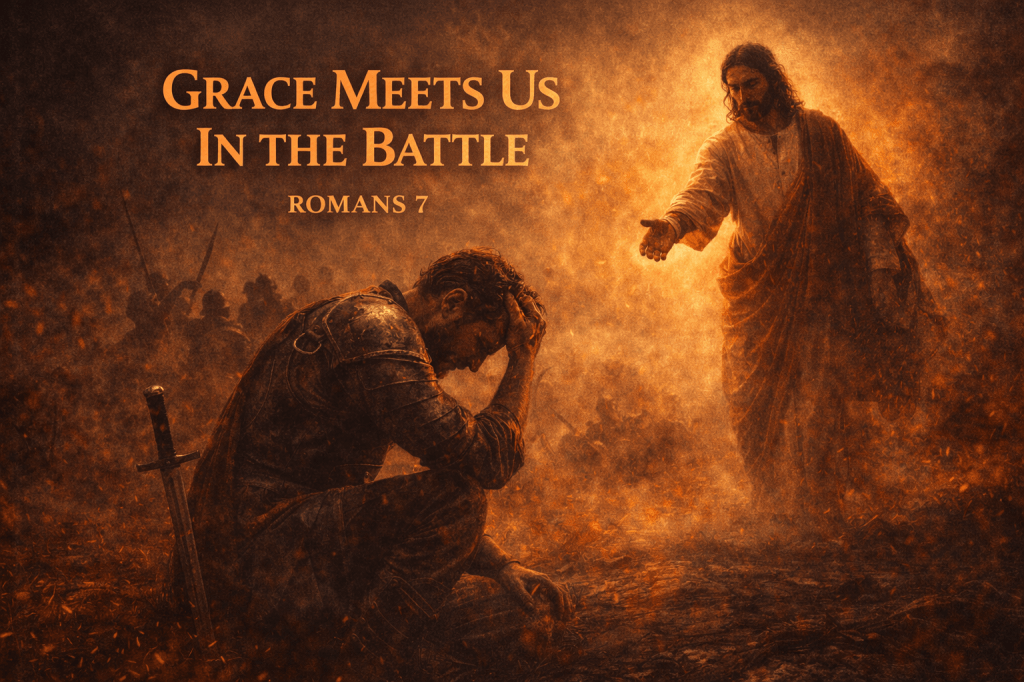
Grace Meets Us in the Battle
Romans 7 does not end in despair. Paul cries out, “What a wretched man I am! Who will rescue me from this body that is subject to death?” That question is not rhetorical. It is desperate. It is the cry of a man who understands the limits of self effort.
And then comes the answer.
“Thanks be to God, who delivers me through Jesus Christ our Lord.”
Deliverance does not come through trying harder, it comes through dependence. It comes through surrender. It comes through the Spirit that Paul will fully unpack in Romans 8.
This matters deeply for men who are serious about growth. Struggle is not a sign that grace has failed, it is the environment where grace is applied. Sanctification happens in the tension, not after perfection is achieved.
Living With Awareness, Not Shame
Romans 7 invites us to live honestly. To stop pretending the battle is over. To stop hiding our struggle. To stop measuring our faith by the absence of temptation rather than by the presence of dependence.
When you notice yourself slipping into distraction, apathy, or old habits, do not see it as evidence that you are broken beyond repair. See it as a signal. A reminder. A call back to the Word. A call back to prayer. A call back to the Spirit who alone can fuel transformation from the inside out.
My Major Lesson Learned in this: Struggle does not disqualify you. It reminds you where your strength comes from.
Paul’s words free us from the lie that maturity means ease. They ground us in the truth that growth means engagement. The war within is not proof of defeat. It is proof that something new is alive inside you, pushing back against what once ruled unchecked.
A Question That Carries Forward
Paul describes two laws at work within him. The law of sin and the law of the Spirit. Every day, one of them governs your decisions. One shapes your habits. One influences your reactions. The question is not whether the battle exists. The question is which law you are allowing to lead.
What would it look like to surrender control more fully? To let the Spirit shape not just your beliefs, but your rhythms, habits, reactions, and priorities? To notice the tug of the Spirit and respond rather than resist?
Romans 7 does not leave us hopeless. It prepares us. It strips away illusions of self sufficiency and sets the stage for the freedom of Romans 8.
Grace does not wait for the battle to end.
Grace meets you in the middle of it.
And that is where real growth begins.
 Unleashed By Faith
Leave a comment