


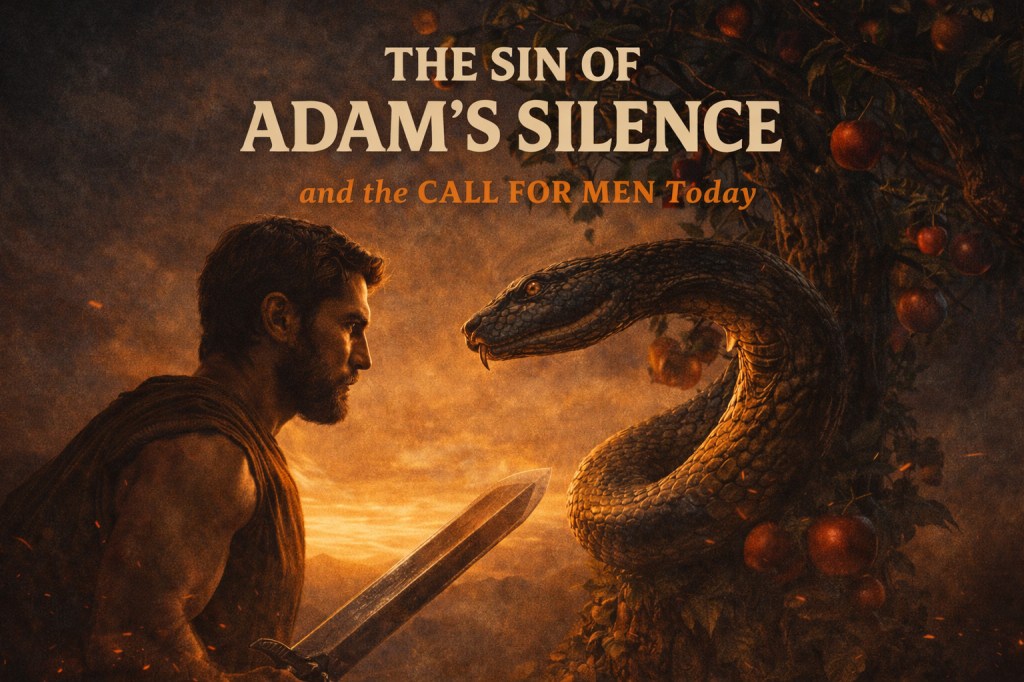
Scripture: Genesis 2–3; Ezekiel 33:6; Romans 12:2, 12:21; James 4:17; 1 Peter 5:8; Joshua 24:15
Adam’s Fall Began with Silence
Adam’s fall did not begin with eating the fruit. It began with silence.
Genesis 3 records the serpent speaking directly to Eve, questioning God’s command and introducing deception. Eve listens, reasons, and eats. She then gives the fruit to Adam, who is described as being “with her” (Genesis 3:6). The text is explicit. Adam was present. Yet Scripture records no objection, no correction, and no resistance from him.
Adam knew God’s command.
Adam recognized the lie.
Adam remained silent.
Only after this silence does Adam act in disobedience. Scripture shows that his failure began before the fruit ever touched his hand. James later clarifies this principle plainly:
“If anyone knows the good they ought to do and does not do it, it is sin for them.”
(James 4:17)
Adam’s first sin was not ignorance. It was abdication. He failed to do the good he knew was required of him.
God Had Already Given Adam a Responsibility to Guard
Before the fall, God assigned Adam a clear responsibility.
“The Lord God took the man and put him in the Garden of Eden to work it and keep it.” (Genesis 2:15)
The Hebrew word translated “keep” carries the meaning of guarding, watching over, preserving, and protecting what has been entrusted. This was not merely agricultural care. It was a call to vigilance and stewardship.
Adam was commanded to guard what God declared good. When deception entered the garden, Adam did not fulfill that role.
The serpent did not overpower Adam physically. He did not remove Adam from the scene. He spoke lies, and Adam allowed those lies to stand unchallenged. The garden and his wife were compromised not through force, but through neglect.
Scripture Repeatedly Condemns Silent Guardians
The pattern introduced in Genesis appears throughout Scripture. God consistently holds accountable those who see danger and refuse to speak. In Ezekiel, God speaks of a watchman who sees destruction coming and fails to warn the people:
“If the watchman sees the sword coming and does not blow the trumpet… I will hold the watchman accountable.” (Ezekiel 33:6)
The watchman is not condemned for lacking strength. He is condemned for failing to warn or staying silent.
This principle applies directly to Adam and to men today. Responsibility includes speaking, warning, and acting. Silence is not remaining neutral. It is a failure of duty.
Evil Advances Through Passivity, Not Just Rebellion
Paul reinforces this idea when he writes:
“Do not be overcome by evil, but overcome evil with good.” (Romans 12:21)
Evil doesn’t need to defeat good through confrontation alone. Evil advances when good fails to act. If good does nothing, evil prevails by default.
Adam was not overcome because he fought and lost. He was overcome because he did not fight at all. This same dynamic is at work today. When men withdraw from responsibility, deception gains ground.
Guarding the Home Begins With Guarding the Mind
Paul also warns believers against passive absorption of worldly influence:
“Do not conform to the pattern of this world, but be transformed by the renewing of your mind.” (Romans 12:2)
Conformity requires no effort. It occurs when resistance is absent. Transformation, however, is intentional and active. To conform is to be shaped by an external mold. To be transformed is to allow God to reshape the mind according to His truth.
Applied to the home, this principle carries real weight. A household will be shaped by ideas, values, and influences whether those influences are chosen deliberately or allowed by default. Scripture makes clear that passivity does not preserve neutrality. It simply hands formation over to the loudest voice.
Adam allowed a foreign worldview to enter the garden without challenge. Paul’s warning calls men to avoid repeating that failure. Guarding the home, therefore, begins with guarding the mind and resisting any pattern that contradicts God’s design.
Vigilance Is a Repeated Biblical Command
Peter makes the danger explicit:
“Be alert and of sober mind. Your enemy
the devil prowls around like a roaring lion looking for someone to devour.”
(1 Peter 5:8)
The call is not to fear, but to vigilance. Spiritual danger does not announce itself politely. Alertness is required. Adam failed to remain alert. Scripture calls men not to repeat that failure.
Men Are Called to Set the Direction of the Household
Joshua understood this responsibility clearly when he declared:
“As for me and my household, we will serve the Lord.” (Joshua 24:15)
Joshua does not defer responsibility or outsource spiritual leadership. He accepts accountability for the direction of his home. Scripture presents this not as dominance or control, but as faithful stewardship under God.
A man is not called to coerce his family into obedience, nor to rule through force or fear. He is called to guard the direction in which his household moves. Direction implies guidance, example, and consistency rather than domination.
God has equipped men with instincts toward order, discipline, and steadiness so they can anchor the home when emotions fluctuate and pressures arise. When a man leads well, he creates an environment where truth is clear, values are consistent, and the family is oriented toward faithfulness rather than confusion.
Leadership in the home, as Scripture defines it, is not about lording authority. It is about setting a faithful course and remaining accountable for where that course leads.
What This Means for Men Today
Taken together, Scripture presents a consistent message:
- God entrusts men with responsibility to guard what He gives them
- Silence in the face of deception is sin
- Evil advances when men retreat
- Protection is primarily spiritual and moral
- Vigilance, discernment, and truth-speaking are required
- Men are accountable for the direction of their households
This does not require brute strength. It requires faithfulness.
A man protects his family when he speaks truth, resists deception, sets boundaries, and refuses to remain passive. His voice, rooted in God’s Word, becomes a primary means of protection.
The Call to Reclaim What Adam Surrendered
Adam surrendered his voice. Scripture calls men to reclaim it.
Not with anger.
Not with dominance.
But with conviction grounded in God’s Word.
A man who refuses to remain silent becomes a source of stability for his family. A man who guards what God entrusts becomes a defender against deception.
This is not cultural masculinity. This is biblical responsibility.
And it is still God’s design.
 Unleashed By Faith
Leave a comment